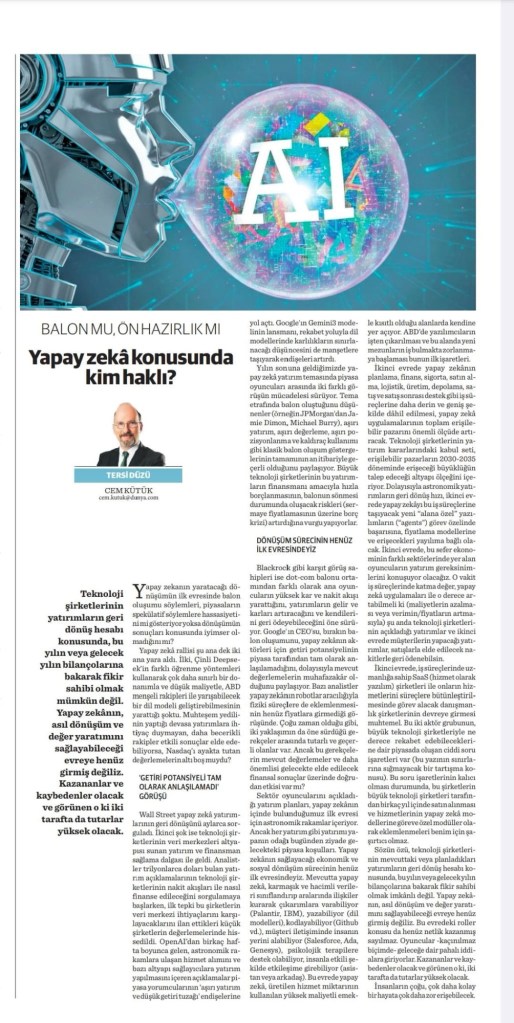
When it comes to calculating the return on investment for technology companies, it is not easy to form an opinion by looking at this year’s or next year’s balance sheets. We are still far away from the phase where AI can deliver real transformation and value creation in business processes. There will be winners and losers on the journey there, and it appears that the stakes will be high on both sides.
The talk of a bubble forming in the early stages of the transformation might indicate the markets’ sensitivity to speculation, or it might reflect the pessimism about the results of the transformation, depending on one’s interpretation.
The AI rally has suffered two major blows so far. The first was the shock caused by Chinese company
DeepSeek developing a language model that could compete with its US-based rivals using very limited
hardware and incomparably low costs, thanks to different learning methods. The investors lost sleep over the news that a young startup could build something quite competitive vs. the massive investments by the magnificent seven. Regarding sky high valuations in Nasdaq, such a competitive threat could cause massive selling wave if the market is convinced there is not much of a solid moat gained through those investments. Wall Street questioned the return on artificial intelligence investments for months.
The second shock came with a wave of investment and financing rounds for young companies providing data center infrastructure. As analysts began to question how these investment announcements amounting to trillions of dollars by OpenAI and others would be financed by their cash flows, the initial reaction was felt in the valuations of those young companies they make agreement with to use the capacity of the data centers they will build. Announcements from OpenAI over several weeks, involving astronomical service purchases and investments in those infrastructure providers, led to market commentators’ concerns about an “over investment and low-return trap”. The launch of Google’s Gemini3 model also made headlines, raising concerns that profitability in language models would be further limited through competition.
At the end of 2025, two different views continue to battle it out among market players on the theme of
artificial intelligence investment. Those who believe a bubble has formed around the theme (e.g. Jamie
Dimon and Michael Burry) share that all the classic indicators of bubble formation, such as excessive investment, overvaluation, over-positioning and leverage, are currently valid. They emphasize that
the rapid borrowing by large technology companies to finance these investments increases the risks that would arise if the bubble bursts (a debt crisis on top of capital pricing).
Opponents such as Blackrock, however, argue that unlike the dot-com bubble environment, the main
players are generating high profits and cash flow now, investments will further increase revenues and profits, and that they will not have a problem paying back any financing. Google’s CEO claimed that, leaving aside the formation of a bubble, the market does not fully understand yet the potential returns for artificial intelligence players, and therefore current valuations are even conservative. Some analysts believe that the integration of AI into physical processes through robots has not yet been priced in. Both sides have arguably solid arguments.
The investment plans announced by industry leaders contain astronomical figures for the current (early) stage of AI’s engagement in the economy. However, like any investment, the focus of the investor is on future market conditions rather than the present. We are still in the early stages of the economic and social transformation that AI will possibly trigger. Today AI can classify complex and voluminous data, establish relationships between them, and draw conclusions (Palantir, IBM), write (language models), code (Github, etc.), replace employees in customer communication (Salesforce, Ada, Genesys), support psychological therapies, and interact effectively with humans (as assistant or companion). At this stage, it is finding its place in areas where the amount of service produced is limited by the high cost of labor involved in the production process. The first signs of this are the layoffs of software developers in the US and the difficulty new graduates are starting to have in finding jobs in this field.
In the second stage, the deeper and broader integration of AI into business processes such as planning,
finance, insurance, purchasing, logistics, production, storage, sales, and after-sales support will significantly increase the total accessible market for its pioneers. The assumption set used in Big Tech’s investment decisions includes the infrastructure scale that this level of accessible markets will require in the 2030-2035 period. Therefore, the return rate on these investments will depend on (I) the success of new ‘domainspecific’ software (‘agents’) that will bring AI into business processes at that stage, and (II) on pricing models and the diffusion they achieve. Then press coverage will shift to the investment requirements of main players in different sectors of the economy to have these agents in place. At that point, the question will be whether added value created in business processes with AI (through reduced costs or increased efficiency/prices) should be enough to pay back the investments currently announced by Big Tech and those will be made by their customers then.
In the second stage, SaaS (software as a service) companies with expertise in business processes and
consulting firms that are tasked with integrating SaaS solutions into these processes will possibly be the main enablers of AI. Analysts are concerned about the extent to which these two groups of players will be able to compete with Big Tech (a topic of discussion that is beyond the scope of this article). If these concerns persist, I will not be surprised to hear announcement of the deals Big Tech are acquiring SaaS players and consultant firms within a few years to integrate their data and capabilities to AI models as taskspecific “add-in” modules.
The uncertainty does not deter Big Tech from making costly claims through investments about the future since fear of missing out on the competition overcomes prudence and conservatism, at least for now. There will be winners and losers, and it appears that the stakes will be high on both sides.
Following huge transformation ahead, most people will probably find it much harder to afford a much easier life.
- Translation of my article in Dunya Gazetesi (leading Turkish economy newspaper) on 20th of December.

 Cem'in Gezegeni